Parcel
Fulfillment
Parcel
Fulfillment
Company
Stord
Company
Stord
Role
Product Designer
Role
Product Designer
Scope
New experience
Duration
February, 2022 – December, 2022
Duration
Feb – Dec, 2022
Stord is a supply chain company offering a complete package of fulfillment services and software that help B2B and D2C businesses increase sales, save money, and operate more efficiently.
Stord is a supply chain company offering a complete package of fulfillment services and software that help B2B and D2C businesses increase sales, save money, and operate more efficiently.
Video: Stord Fulfillment in Action. Courtesy of Stord.
Background
Background
Stord's Warehouse Management System (StordWMS) lacked effective tools for parcel fulfillment, offering only an inefficient B2B order fulfillment experience. This gap represented a significant missed opportunity to expand the company's warehousing business through robust parcel fulfillment services. As a design partner to the fast-paced WMS engineering team, I jumped on this opportunity by conducting comprehensive user and market research, which shaped a clear experience vision and implementation strategy, supported by intuitive UI designs and seamless interaction flows.
Stord's Warehouse Management System (StordWMS) lacked effective tools for parcel fulfillment, offering only an inefficient B2B order fulfillment experience. This gap represented a significant missed opportunity to expand the company's warehousing business through robust parcel fulfillment services. As a design partner to the fast-paced WMS engineering team, I jumped on this opportunity by conducting comprehensive user and market research, which shaped a clear experience vision and implementation strategy, supported by intuitive UI designs and seamless interaction flows.

Challenges
Challenges
- Complex problem space
- Product maturity: MVP
- Proprietary nature hinders research
- High-velocity R&D team with engineer-based culture
- Limited or non-existent support from data science, research, and design
- Complex problem space
- Product maturity: MVP
- Proprietary nature hinders research
- High-velocity R&D team with engineer-based culture
- Limited or non-existent support from data science, research, and design

My role
My role
- Product Designer
- User Advocate
- A11y Enforcer
- Researcher
- Design Strategist
- Brand Experience Integrator
- Product Designer
- User Advocate
- A11y Enforcer
- Researcher
- Design Strategist
- Brand Experience Integrator

Impact
Impact
The measured impact demonstrates significant improvements in efficiency:
The measured impact demonstrates significant improvements in efficiency:
30–50%
less time spent on order fulfillment
4x
faster packout
3.29x
increase in shipped daily order volume
Assessment & findings
Assessment & findings
Study
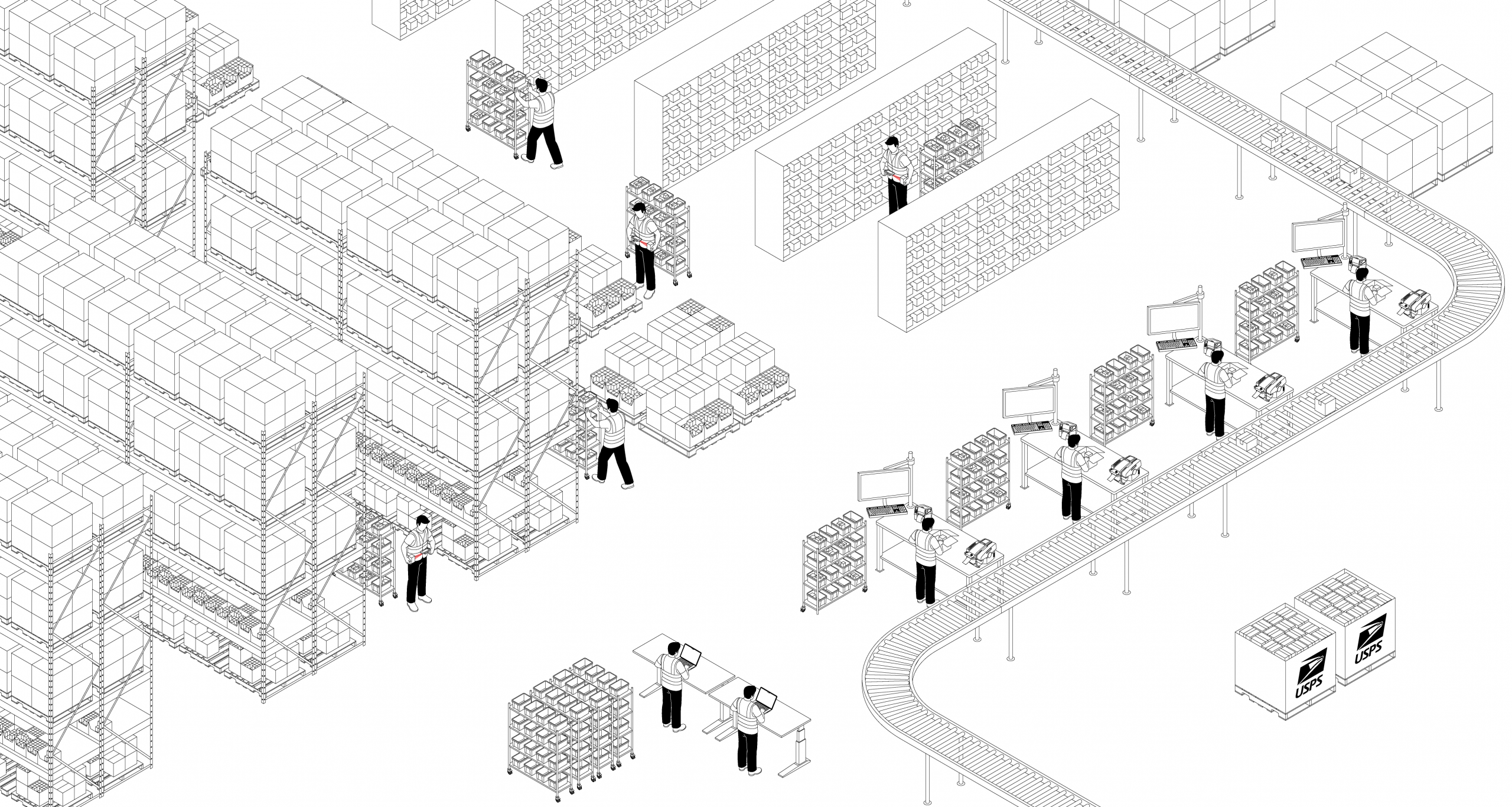
I studied warehouse associates handle picking and packing operations with different WMS software and tested these products and tasks myself.
Analysis
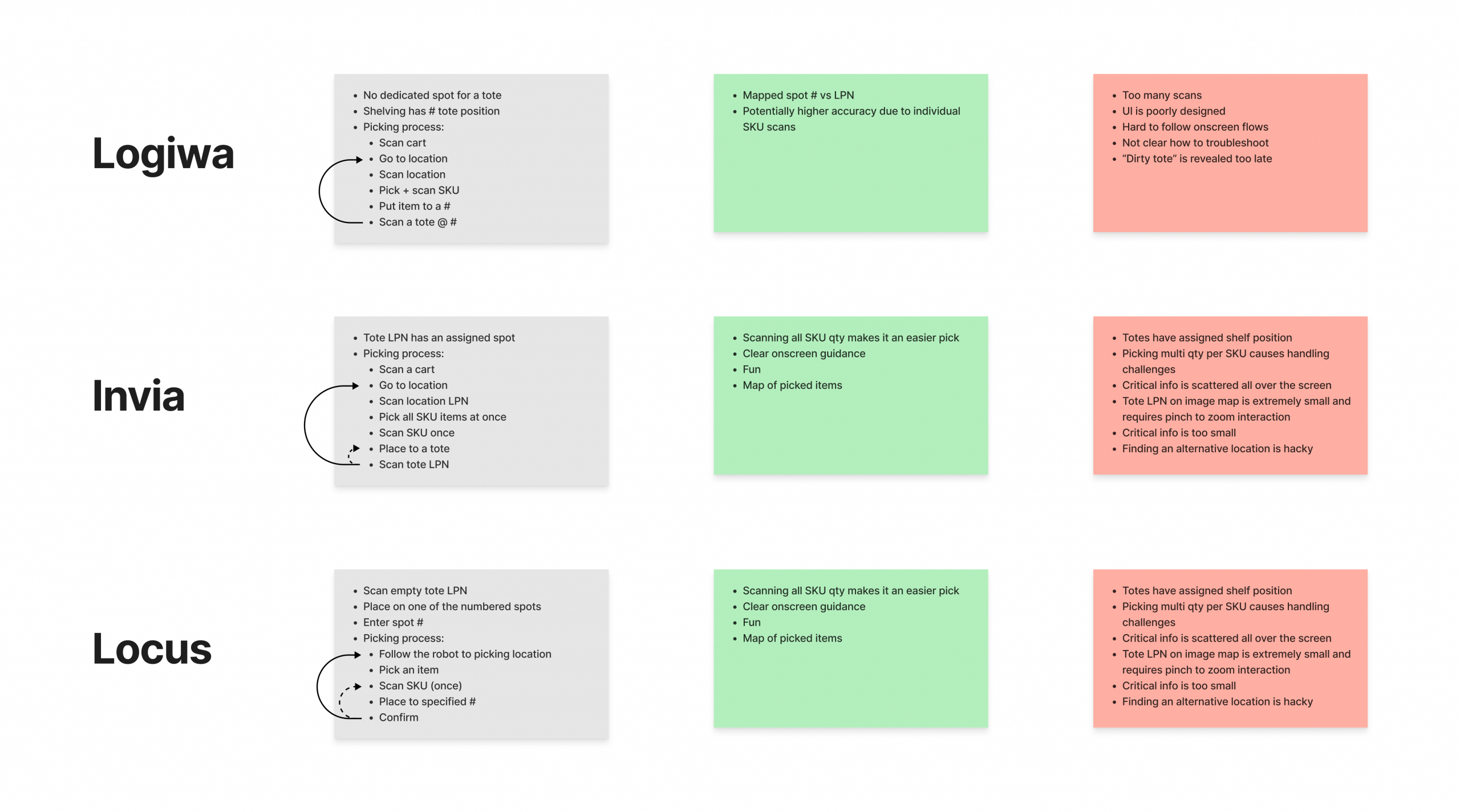
I analyzed the findings through process comparisons, highlighting advantages and shortfalls, leading to the decision to abandon our current picking flow and design a new one.
Research
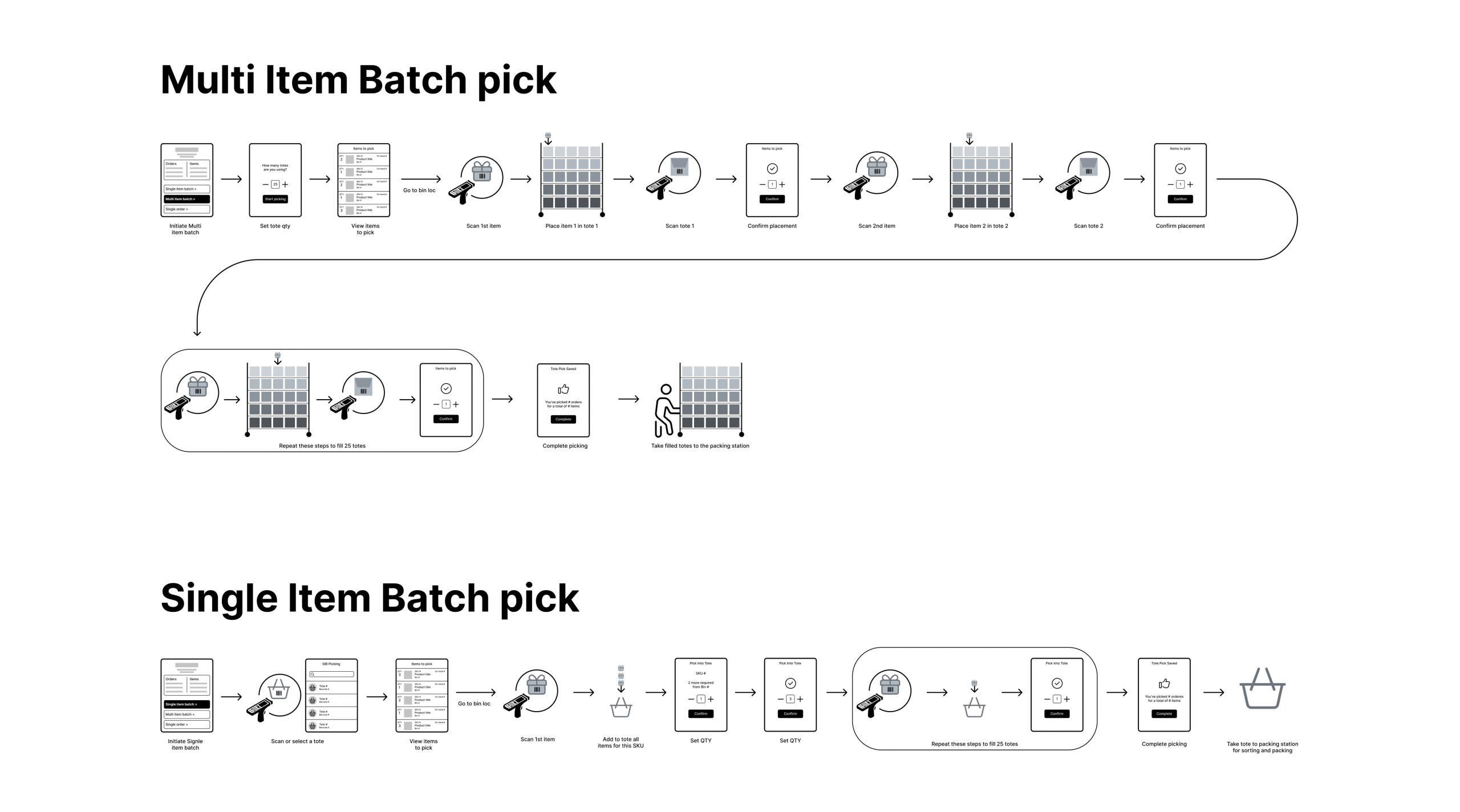
I remotely evaluated competitor products to identify opportunities they missed, capturing each step of the picking process.
Interviews
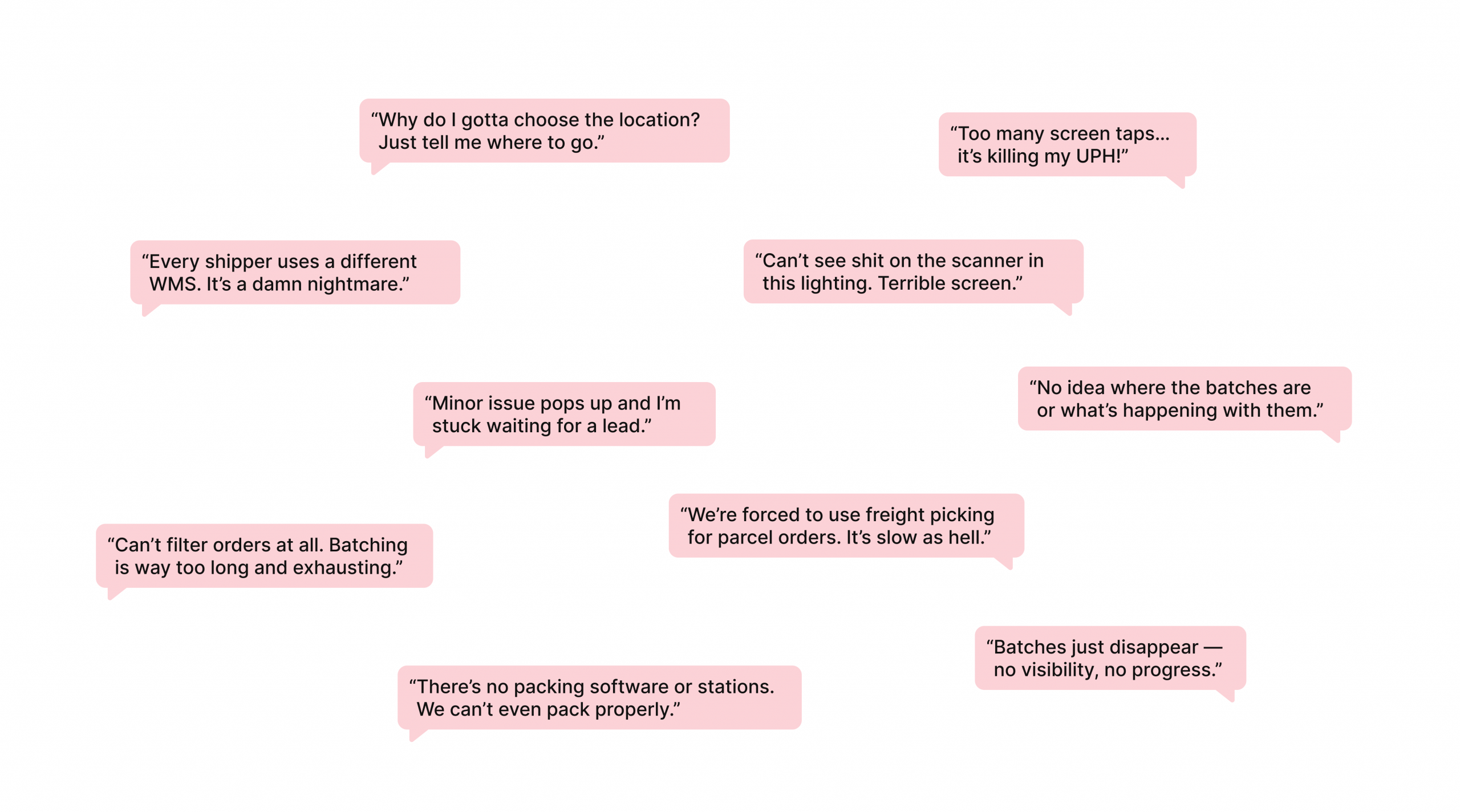
While interviewing various warehouse employees, I learned not only about their different roles, goals, and responsibilities, but also about their daily struggles with the current system.

Account roles
Account roles
I have identified two major user groups that are remarkably opposite by nature and co-dependent by necessity:

Managers
- Trained and experienced industry professionals
- Multiple roles: Shift Leads, Warehouse Clerks, Inventory Specialists, Supervisors, Warehouse Managers
- Role-based WMS access permissions
- Focus: product availability, urgency, efficiency, smooth operations

Associates
- Contract, seasonal and gig workers
- Multiple roles: Pickers, Packers, Forklift Operatorss
- Uniform (lowest) WMS access permissions
- Require supervision, unable to troubleshoot
- Experience time pressure, fatigue, repetitive tasks, pressure to perform
- Focus: Units Per Hour (UPH)

Shortfalls
Shortfalls
- The order batching mechanism couldn’t support an efficient grouping of multiple orders due to lack of essential tools such as order filters
- Poor visibility into batch picking progress
- Pickers could not resolve minor picking issues without a managerial assistance, resulting in abandonment of picking tasks
- Freight picking was the only existing picking method, which was unsuitable for parcel picking
- Packing was non-existent because there were no packing stations and packing software

Pain points
Pain points
- Pickers spent way too much time on on-screen interactions, which was tanking their UPH performance
- Picking flow unnecessarily involves a decision-making process, such as selecting a picking location from multiple options
- Different shippers would use different WMS for picking tasks
- Desktop and scanner experiences demonstrated poor contrast and complete absence of A11y compliance
- No efficient way of tracking order batches
Analysis & strategy
Analysis & strategy

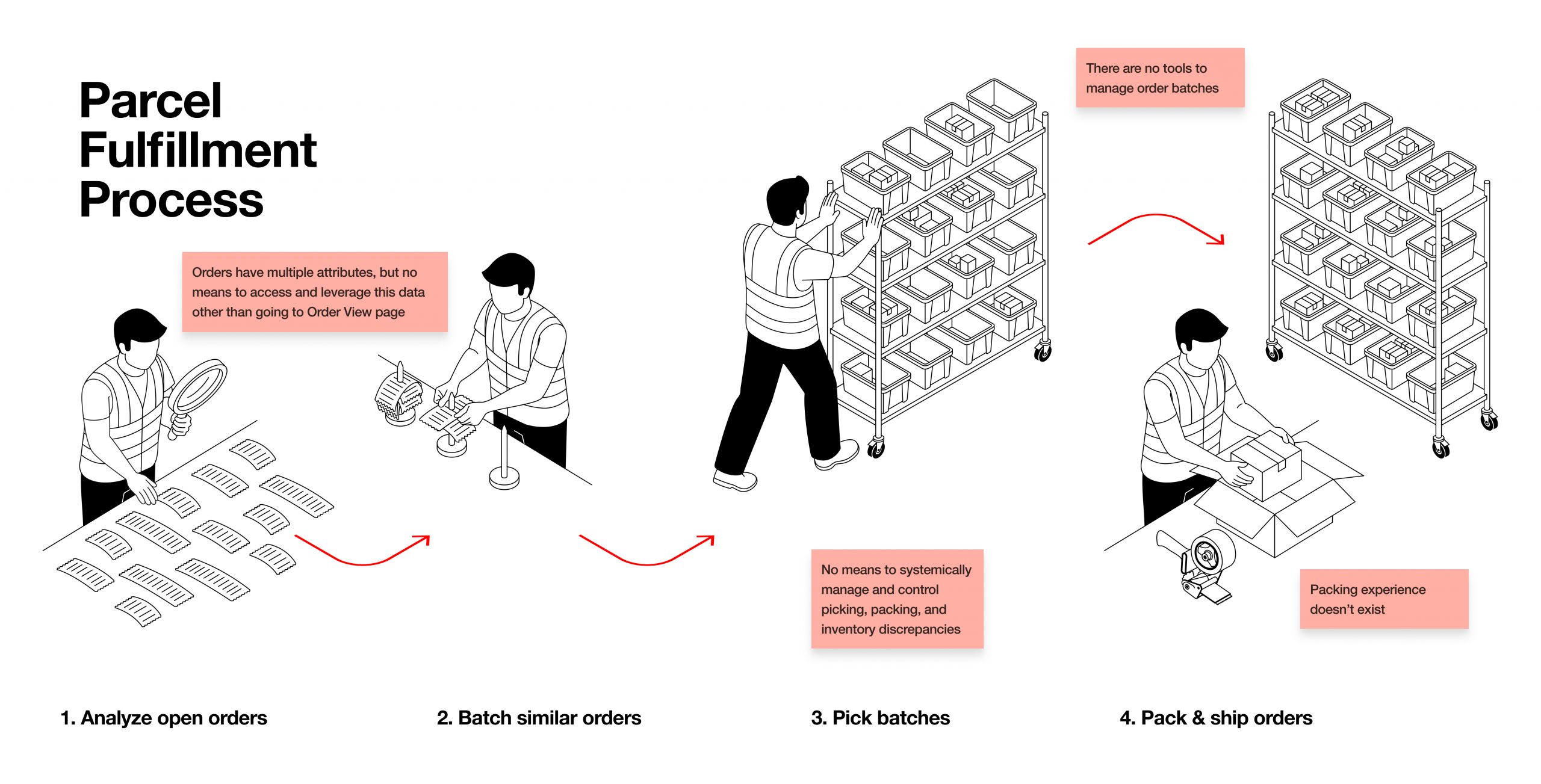
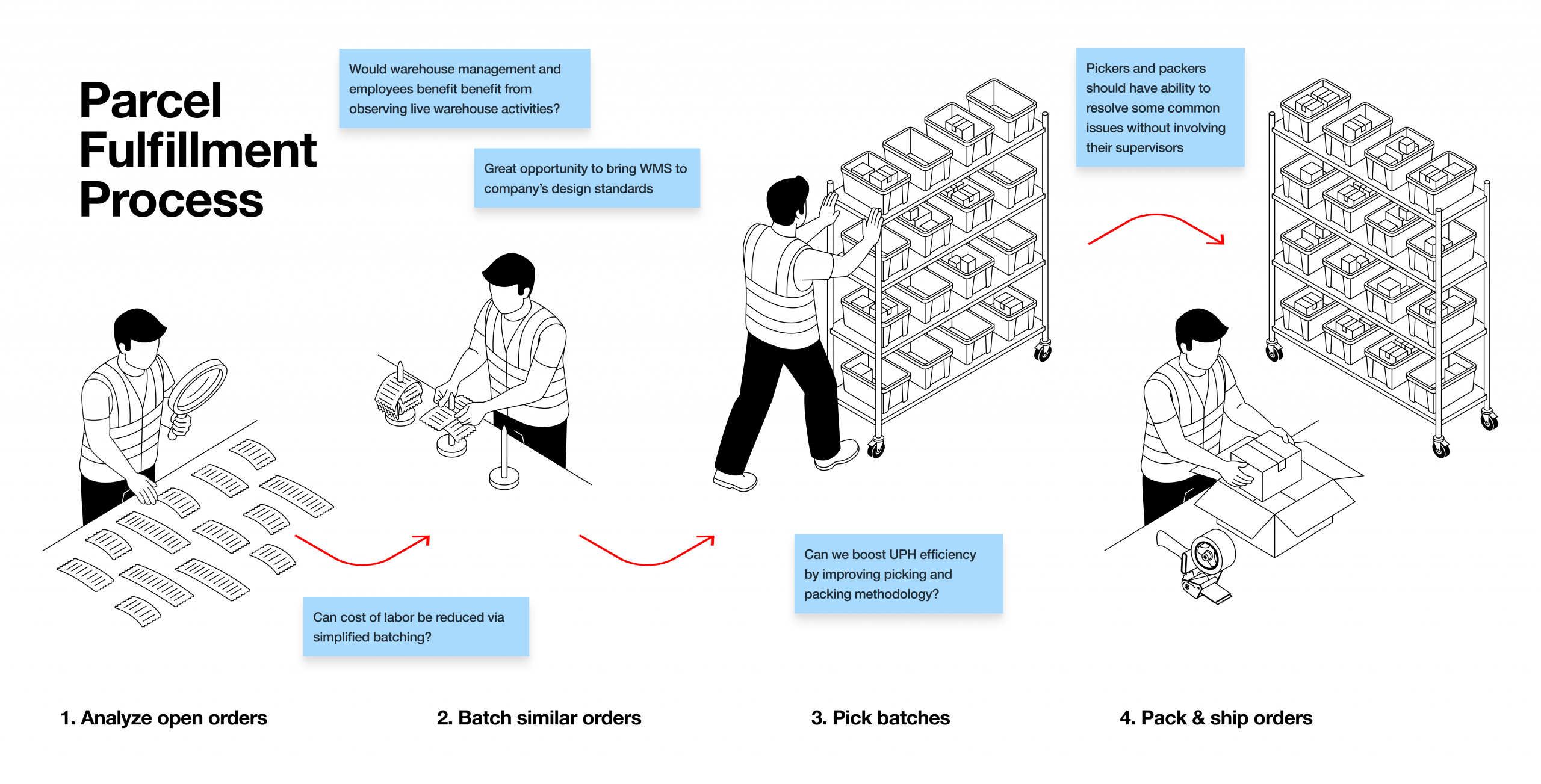
Parcel fulfillment process
Parcel fulfillment process
Informed by findings resulted from experience assessment, I visualized parcel order fulfillment experience and mapped the shortfalls of the existing features, missing and failing pieces, and potential opportunities for further improvements. This greatly helped to strategically prioritize work and develp design standards to follow.
Shortfalls
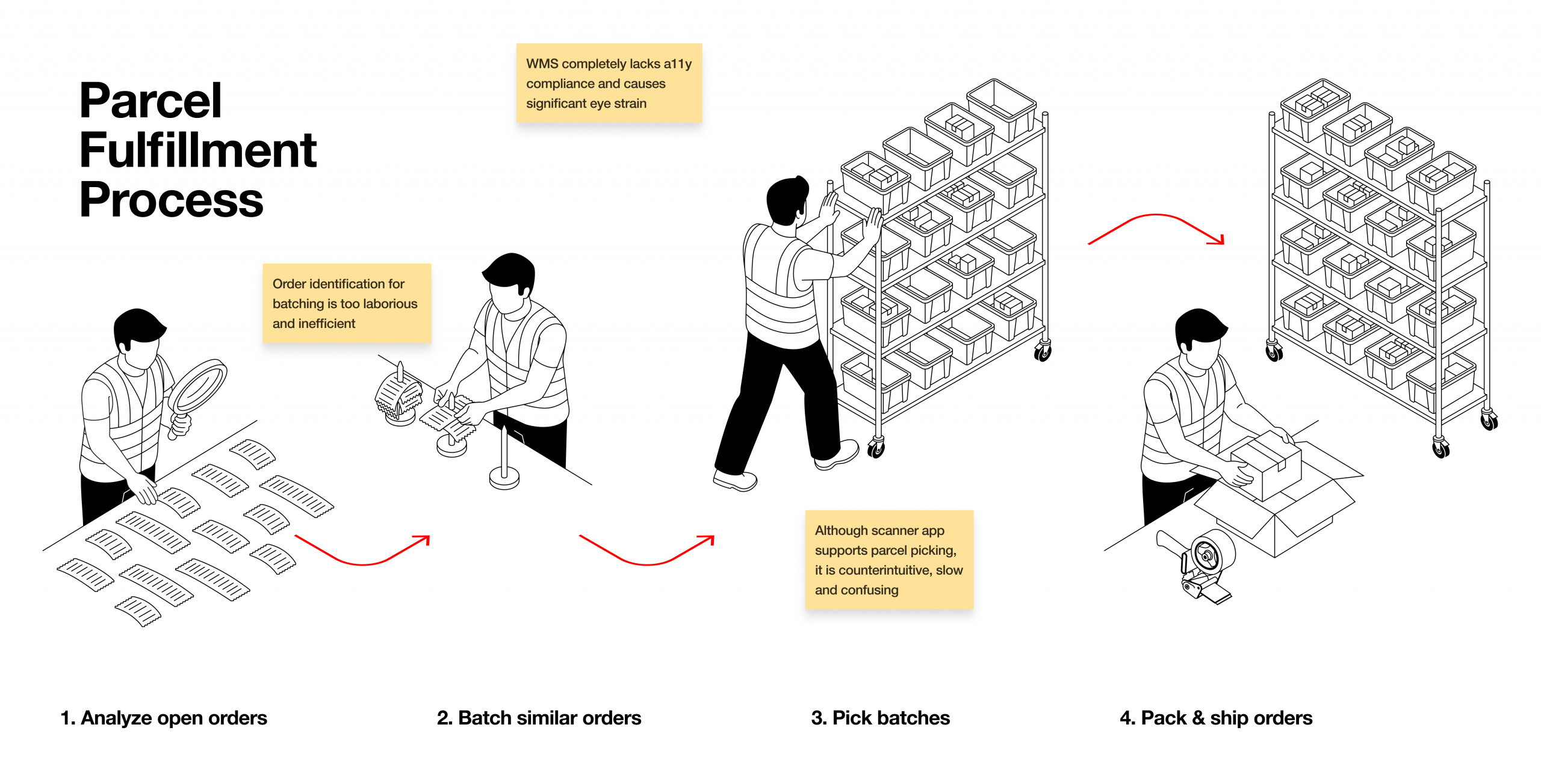
Blocks
Opportunities

Strategy
Strategy
- Design and build packout experience to unblock end-to-end experience while other features are being created or perfected
- Re-design picking experience and flow, so it can support various picking methods
- Elevate outbound orders experience by improving usability and efficiency
- Define batch management experience
- Provide pickers and packers with means to handle discrepancies with orders and inventory.

Tenets
Tenets
- Intuitive user-centric design
- Accessibility compliant experience
- Less interactions, more efficiency
- Stord Design System alignment
- Scalable design that can support both growth and reduction
- Involve warehouse and engineering partners in design process
- Thoughtful balance of industry jargon and plain human speech
- Maximize value, minimize design/tech debt
Design
Design
The design work was following the principle of prioritizing enablement of the experience by designing nonexistent elements over perfecting less important parts.


Quick wins
Quick wins
While designing Parcel Fulfillment, I tackled several out-of-scope but critical gaps causing significant user friction on a global level.
Global navigation
As WMS capabilities expanded, the navigation became a bottleneck. I restructured the architecture to ensure the interface could scale alongside the product without compromising usability.
Old navigation
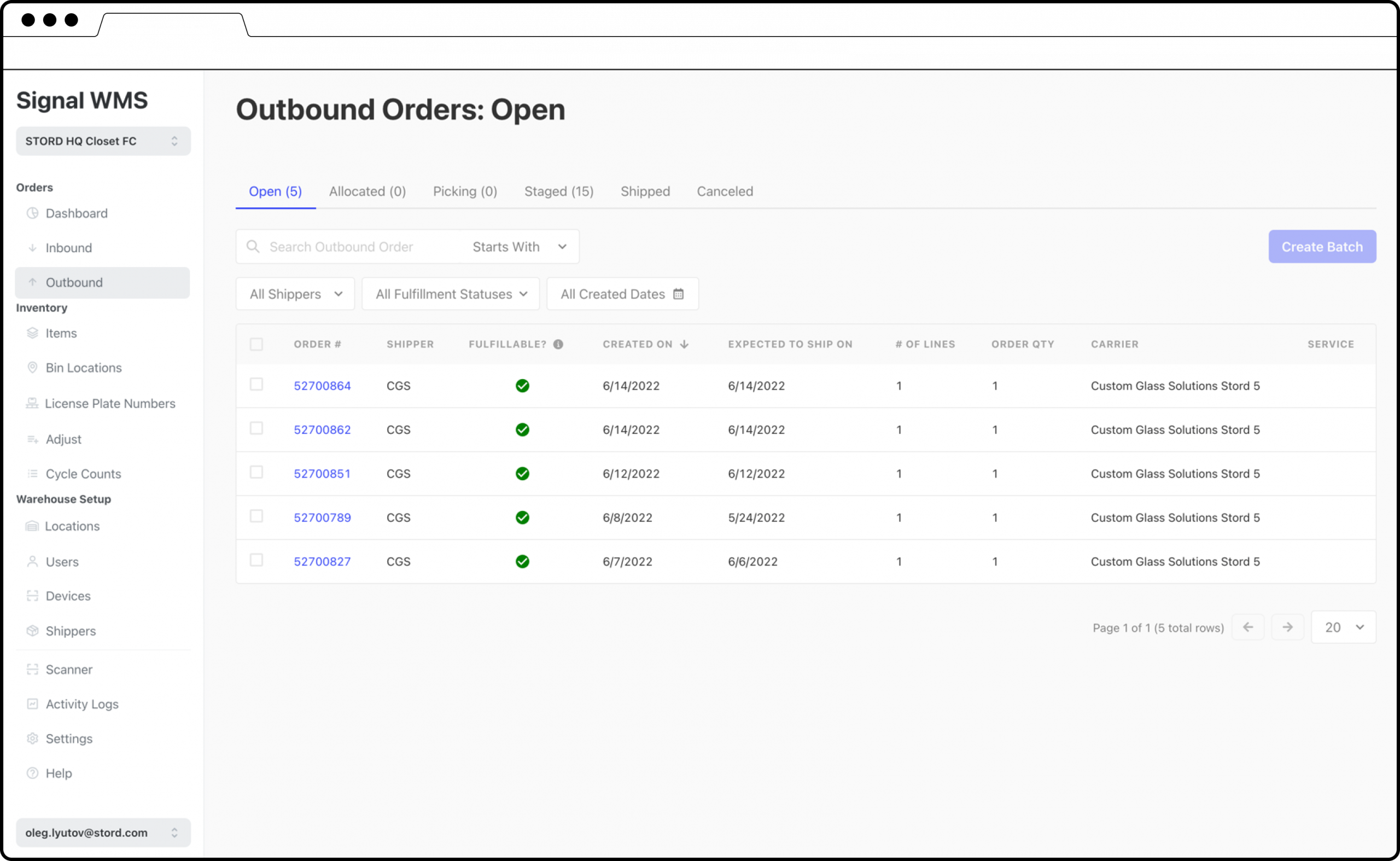
The legacy menu was overcrowded and lacked hierarchy, making it difficult to find tools and impossible to add new ones without increasing clutter.
New navigation
Video Player
I separated operational tasks into a collapsible sidebar and moved system-level items to a top bar, freeing up vertical space and maximizing the viewport for data-heavy workflows.
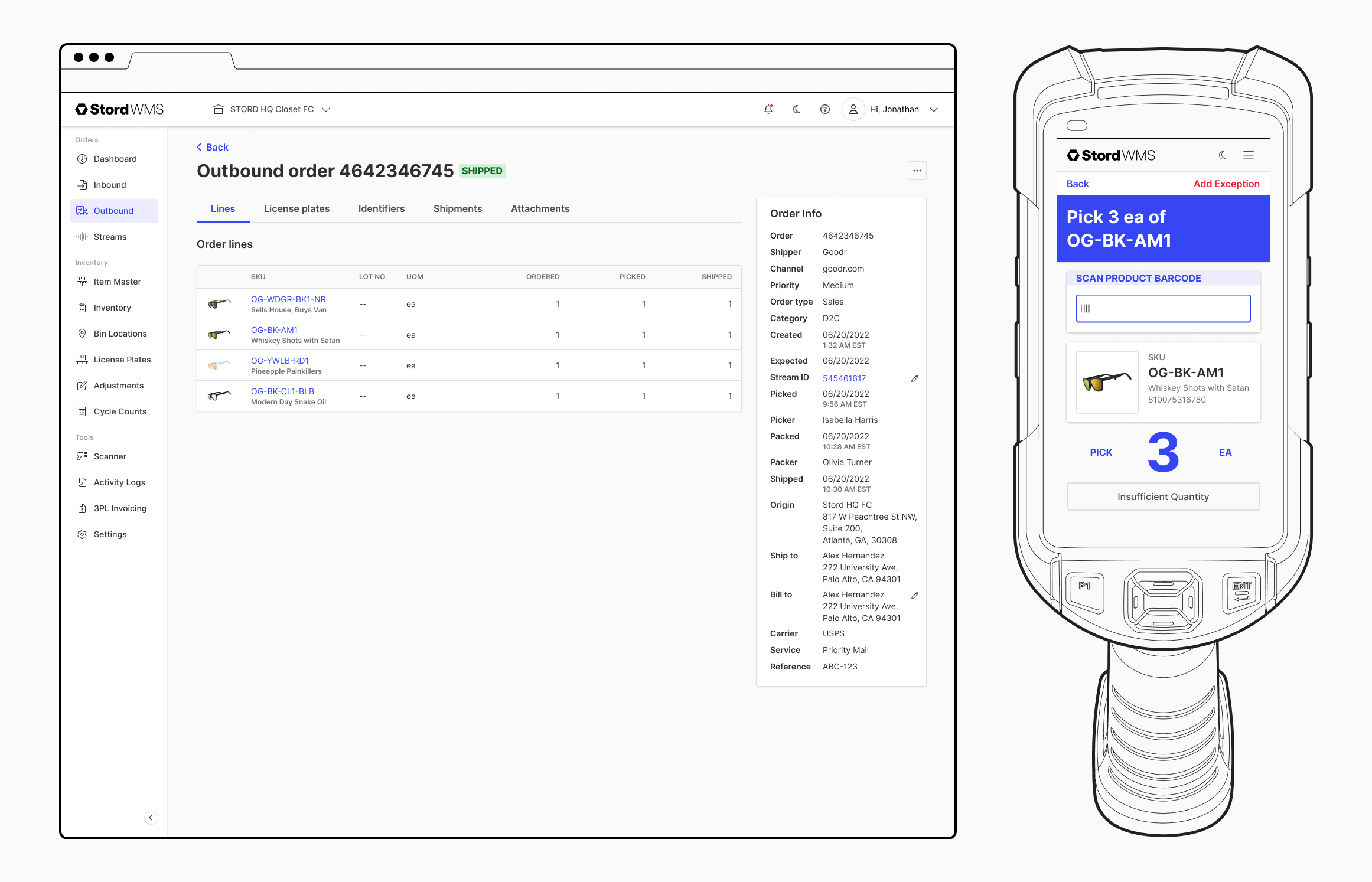
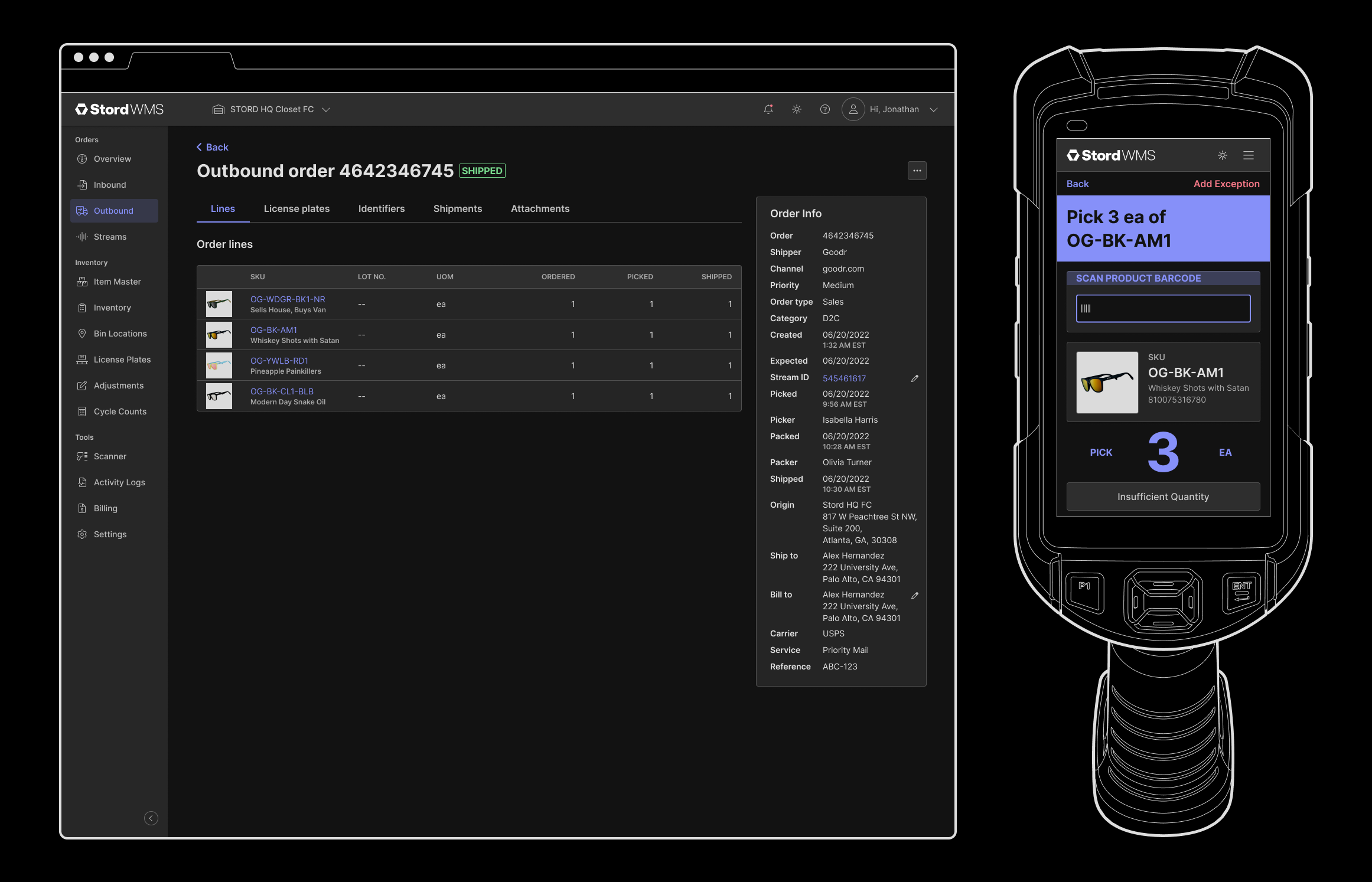
Dark mode
During a hackathon, I prototyped a dark mode that was implemented and shipped within hours. It reached a near-100% adoption rate among staff, as it significantly reduced light emission and eye strain in the dimly lit warehouse environment.
Light
Dark
Accessibility & Design system compliance
Upon joining the WMS team, I identified critical gaps in accessibility and design system compliance, largely driven by a team culture that prioritized engineering velocity over UI refinement. To solve these without impacting speed, I implemented a phased, priority-based strategy that bypassed friction and transitioned the platform to full compliance:
- A11y as a mandate: I framed accessibility as an indisputable engineering requirement, securing immediate buy-in to resolve contrast and navigation issues within the legacy framework.
- Incremental proof of value: I began by introducing foundational atomic elements—colors, buttons, and base components—gradually building up to molecules and organisms. This allowed the team to adopt the new system in manageable stages without a total workflow overhaul.
- Cross-team alignment: I facilitated weekly workshops between the OMS and WMS engineering teams to bridge historically siloed workflows. These sessions fostered a collaborative environment where teams co-developed solutions, ensuring the new UI components were fully compatible with the complex WMS backend.
Before
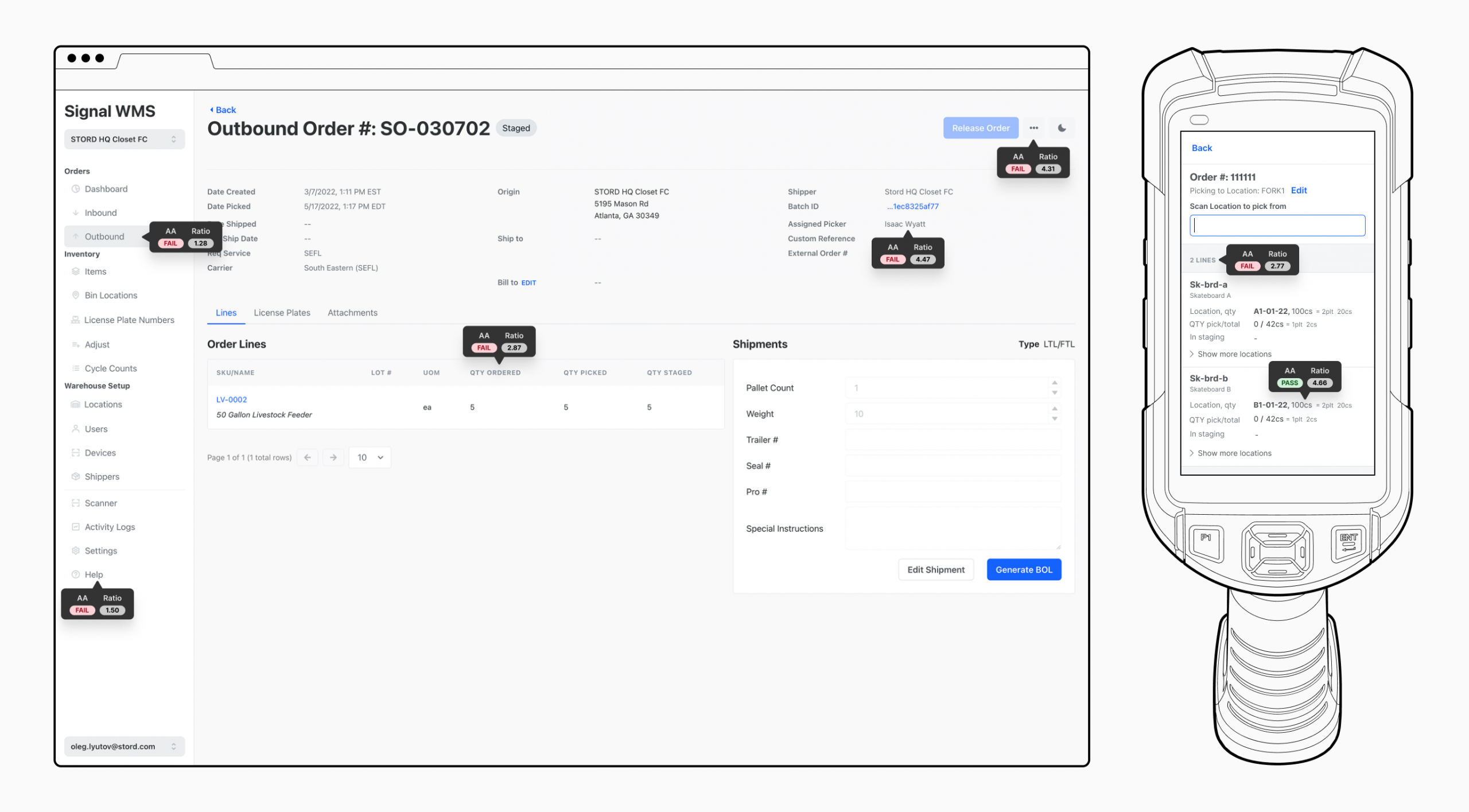
The legacy interface exhibited severe accessibility gaps, with core operational elements failing WCAG contrast standards.
After
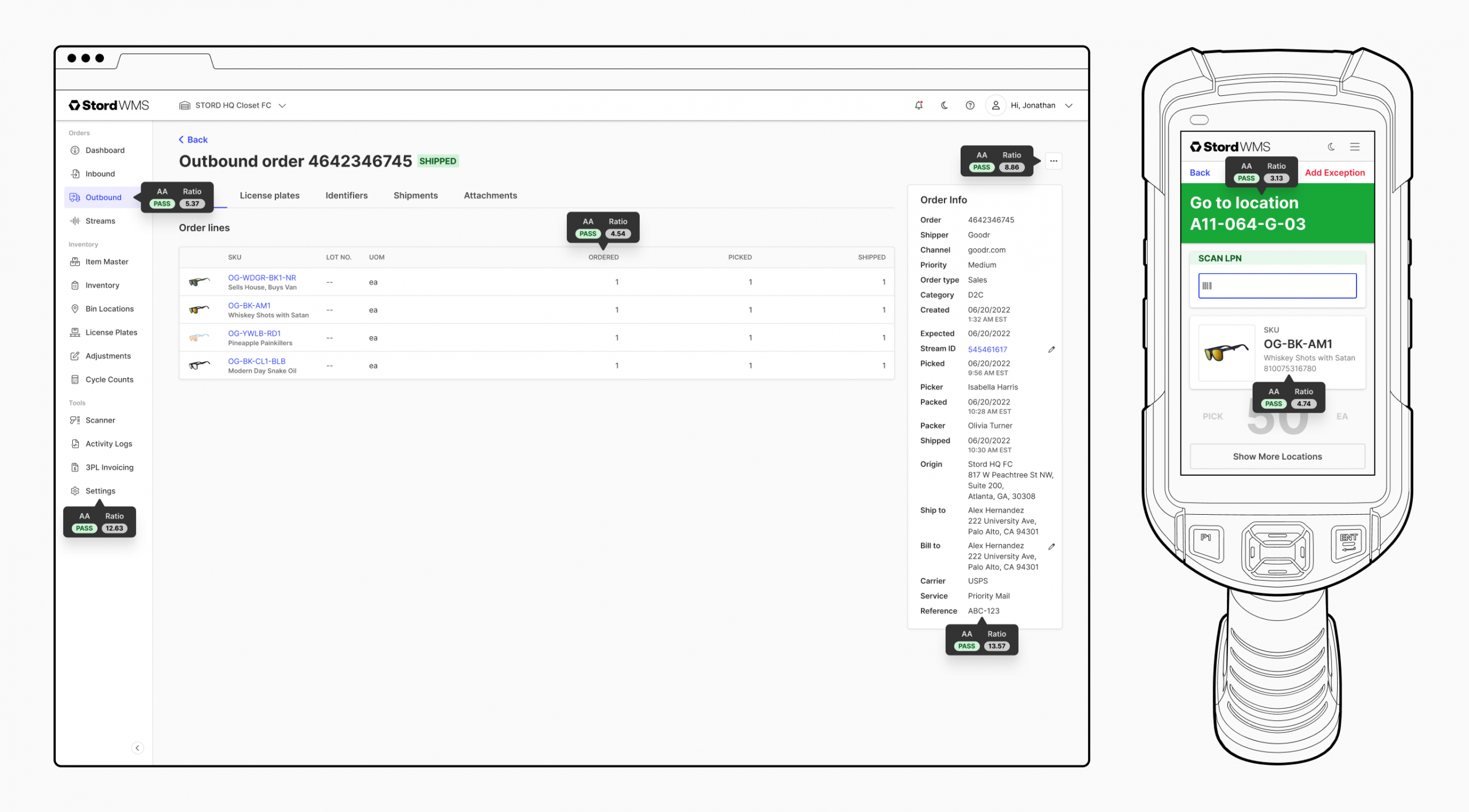
The redesigned interface featuring 95% transition to the new UI, successfully resolving legacy accessibility and compliance gaps.
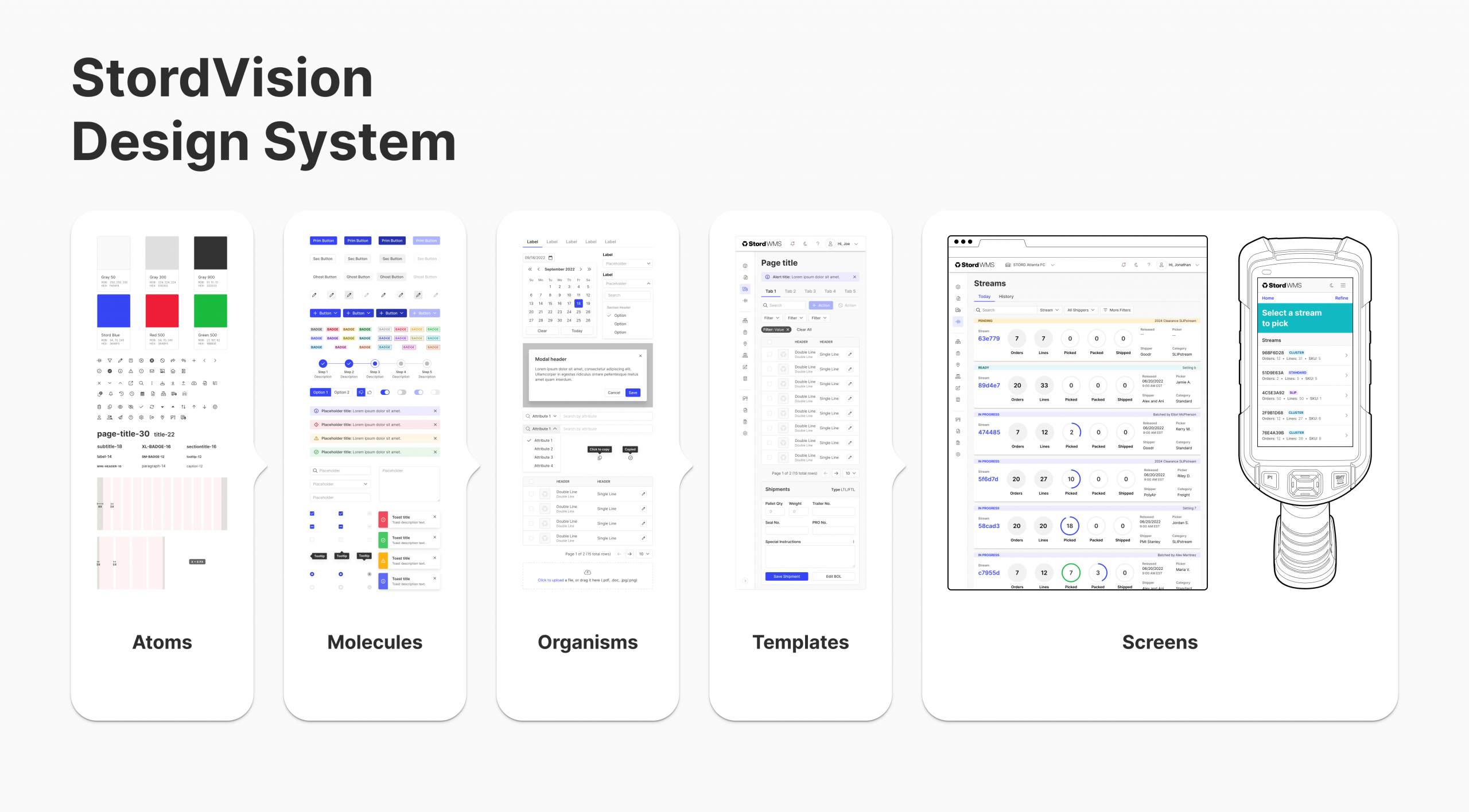
StordVision design system was built on the Atomic Design philosophy by all the members of Stord design team. The system’s Figma-to-code integration empowered designers to bypass manual handoff and push UI updates directly to production.
Outcomes
Outcomes
After analyzing the weaknesses in our legacy freight fulfillment system, I designed a highly efficient parcel fulfillment experience while simultaneously raising freight fulfillment to much higher standards of speed and accuracy.
Six major areas were improved

Packstation
Packstation
Built from scratch, this hands-free experience enabled a full parcel fulfillment cycle that performed with greater efficiency than any known industry competitor.

Scanner
Scanner
By fixing legacy freight picking flaws, the new system removed unnecessary steps and decisions—boosting efficiency, cutting times, and driving shippers to our platform.

Streams
Streams
By enabling live monitoring and remote issue resolution, Streams replaced in-person floor walks with a streamlined digital command center for real-time progress feed.

Outbounds
Outbounds
I refined the Outbounds UI and added more filters, key data points, and a smart order batching widget, greatly improving both order batching speed and efficiency.

Automations
Automations
Leveraging an OMS framework, I designed a custom batching engine for frequent orders—automating the "happy path" and freeing leads for complex batching tasks.

Overview
Overview
The Overview screen displays critical warehouse processes and urgent issues in real time. It became the official WMS homepage and digital signage for the team.
Wins
30–50%
30–50%
less time spent on order fulfillment
less time spent on order fulfillment
4x
4x
faster packout
faster packout
3.29x
3.29x
shipped daily order volume
shipped daily order volume
Shippers
Stord WMS attracted dozens of leading brands that saw great value in its highly efficient parcel fulfillment.
3PL Partners
Stord began generating revenue by licensing its pre-market WMS to 3PL partners, who achieved significant time savings.

“Stord has really helped us to boost our efficiency by getting our orders out quickly. We've had a 30% decrease in the amount of time it takes to pick our orders.”
– Nigel Reid, Operations Manager


“Stord WMS has proven very easy to use and learn by our team. We’re already seeing significant time savings in our outbound processing, cutting required time by about 50%, greatly improved accuracy in our inbounds, and are much better able to track our inventory and pallets.”
– Sam Manley, Director of Business Development

Stord earned multiple G2 awards, driven by strong user reviews praising its WMS parcel fulfillment capabilities.
Takeaways
When I joined Stord, I moved from consumer e-commerce into the complex world of supply chain logistics — a major turning point in my career. As the sole designer on a fast-moving, startup-within-a-startup team, I brought a strong user-centered approach to enterprise software that traditionally lacked it. While leading design for a key Parcel Fulfillment initiative, I learned to navigate intense engineering demands and fragmented workflows. Working autonomously from the rest of the Stord Design Team, I defined the design strategy across multiple areas of the experience — one that respected both the brand’s pillars and the real needs of warehouse workers and their environment. This project, along with several other major initiatives, delivered a much more intuitive fulfillment experience that improved operations and drove meaningful profitability and market competitiveness.